

Part 1 / Conceptualization
THE PROBLEM
High-performance electric aircraft faces the critical problem of waste heat generated by electric motors and battery systems. Conventional cooling methods rely on intake ducts and internal radiators, which introduces significant cooling aerodynamic drag and limits the applicability of electric propulsion systems.
THE SOLUTION
Under the Institute of Aircraft Design, I contributed to the design validation of a novel skin heat exchanger (SHX), consisting of a fibre composite sandwich with a folded core created through origami techniques. The SHX will be installed on the upper-fuselage area of the aircraft - hence the term skin.
Folded Core
This architecture allows coolant to flow through integrated channels which span the entire SHX.
Surface Cooling
Effectively and efficiently transfers heat from the aircraft’s outer surface into the surrounding airflow.
80% Efficiency
From battery-to-motorshaft. Significant increase from previous iterations due to reduced aerodynamic drag.
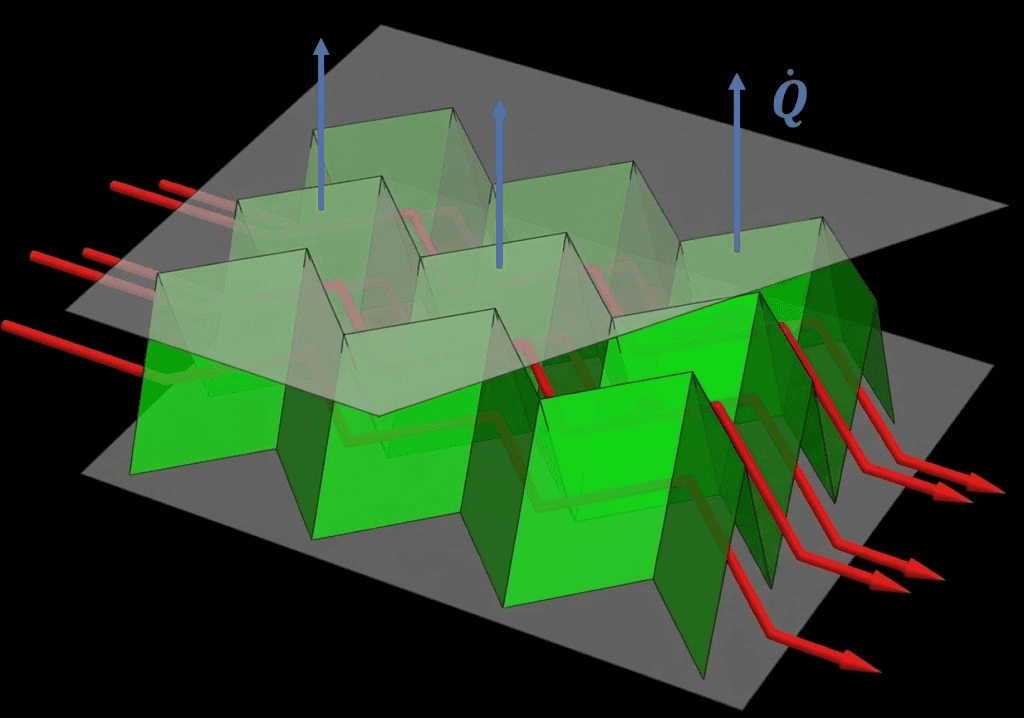
SHX coolant flow path (red) and heat exchange rate (blue).

Fabricated SHX assembly.
Part 2 / Development & Integration
During my first month at the institute, I fabricated glass-fibre components via pre-preg lay-up and resin infusion techniques. To ensure maximum structural integrity under operational stresses, I applied my knowledge of composite chemistry to determine fibre layer quantity and orientation. I also performed post-processing operations such as vacuum bagging, trimming, and sanding.

Glass-fibre coolant distributors and drip-pan.

Coolant distributor with resin-bonded channels.
With the manufacturing complete, I spent roughly the next month designing and building Arduino-based circuitry using Hall-effect turbine sensors for coolant flow monitoring. Since the turbine sensors generated raw frequency signals, I developed a program to collect these values over a window of time, calculate an average, and convert into precise flow rates (in L/min). The final step was integrating these flow rate sensors directly into the aircraft's existing CAN (Controller Area Network) bus and periodically sending a message in hexadecimals.
I also developed a leak detection for the drip-pan which outputted real-time alerts, which was essential for the flight testing stage.

Flow rate monitoring system prototype (Hall-effect sensor).

Compacted system with custom housing.

Drip-pan with leak detection system.
