

Part 1 / Conceptulization
THE PROBLEM
As hospitals continue to face staffing shortages and growing demands, robots may become essential in assisting and even facilitating patient care. They could assist with repetitive tasks such as transporting supplies or assuming the role of an assistant during surgical operations.
THE SOLUTION
The SickKids PCIGITI Lab has been evaluating several robotic hands for dexterous pick-and-place applications, one such being the ORCA Hand. The ORCA Hand is an open-source humanoid hand with 17 DoF (4x in thumb, 3x in each finger, 1x at the wrist). Each finger joint is actuated using nylon tendons and Dynamixel servo motors, while a larger Dynamixel servo and timing-belt system control wrist rotation. From first glance, these mechanisms provide the dexterity required to grasp and manipulate objects with different shapes and material properties.
Part 2 / Design & Integration
OBJECTIVES BREAKDOWN
Manufacturing
custom joints for the ORCA Hand via 3D-printing and finger pads via silicone casting.
Designing
a custom 3D-print mounting rig, enabling attachment of the ORCA hand to the Franka robotic arm.
Simulating
a combined ORCA–Franka simulation environment in NVIDIA IsaacSim and configure functional joints.
When I took on this project in September 2025, I identified a major issue with the existing prototype: the tendons used to actuate the finger joints frequently became tangled and snapped under tension. Each tendon was wound around a 3D-printed spool mounted to a servo motor, which extended or contracted the corresponding joint depending on the motor's rotation direction. Overall, the lack of wire organization was a critical issue that needed to be resolved.
My approach:
1) Reduce the slack in each tendon to approximately 5 cm, which is the minimum length required to maintain each joint's full range of motion.
2) Wire the tendons systematically to minimize overlaps and prevent adjacent tendons from interfering with each other, as illustrated in the diagram below.
3) Test tendon materials with different properties, including nylon, steel, copper in various diameters and braided, non-braided configurations.
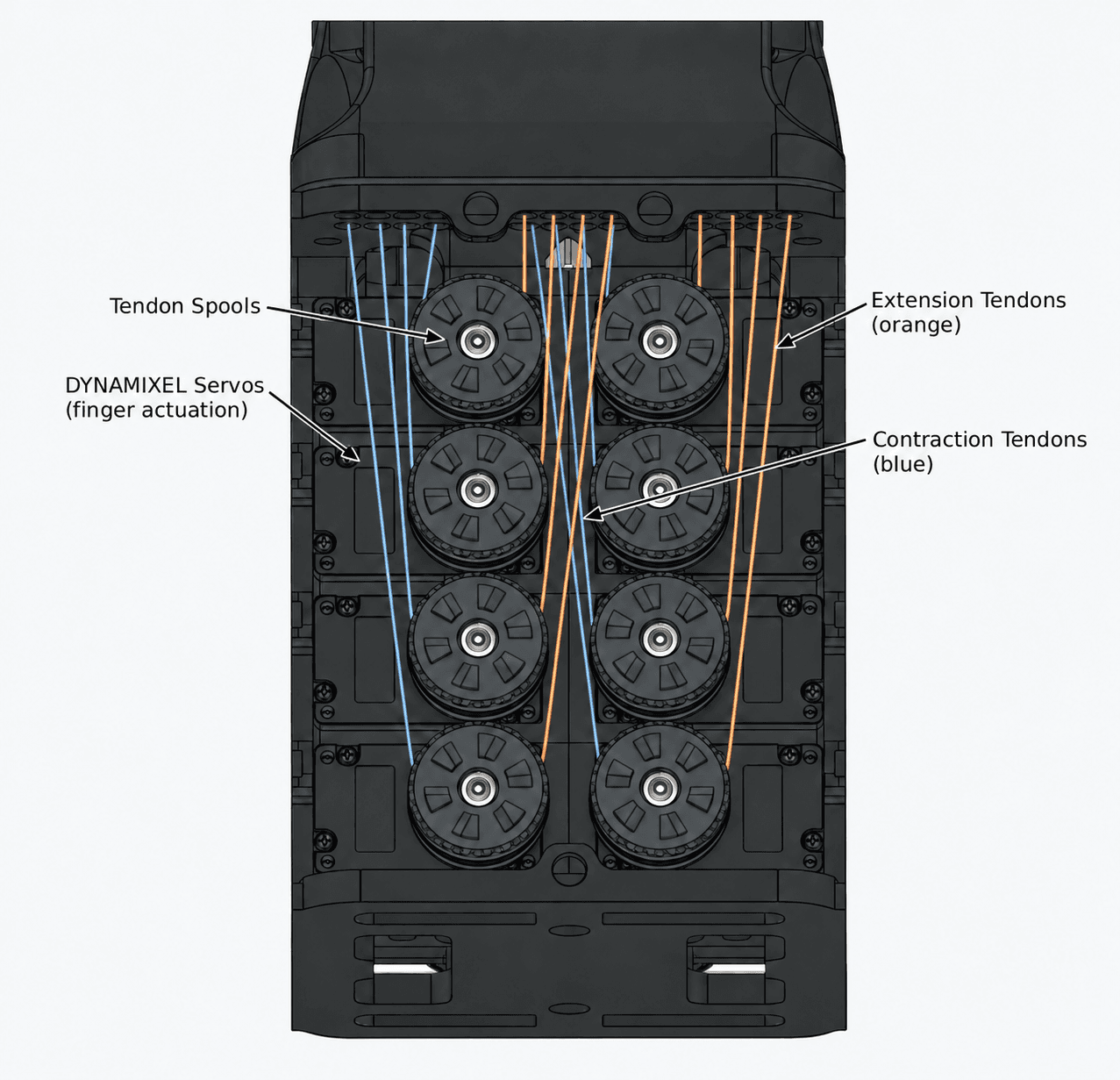
Organized tendon wiring diagram.

Assembling the ORCA Hand joint-by-joint.

Each joint is actuated by 2 separate tendons (for a total of 32).
After several iterations, I found that steel wire was most durable, but resulted in jittery, vibratory motion. The added durability was not a worthwhile tradeoff, as this would've reduced the overall precision of the hand. I ultimately selected 0.4 mm diameter, 8-strand braided fishing line with an approximate load rating of 70 kg.
Movement of the ORCA Hand with hard-coded joint actuation.
Part 3 / Simulation
Before working with the physical prototype, I decided to develop a custom ORCA-Franka simulation environment using NVIDIA Isaac Sim. This was a large learning curve for me, I had to not only familiarize myself with the software but also with operating Linux OS.
Isaac Sim comes with a preconfigured model of the Franka Emika Panda robotic arm. I had to create a custom ORCA Hand by converting the CAD assembly into a URDF model, imporiting it into Isaac Sim, and configuring its links, joint constraints, and collision properties. I then created a fixed connection between the ORCA Hand and the Franka’s end effector to create the unified system.
I am currently developing a Python-based control algorithm using Isaac Sim's Core API to evaluate pick-and-place tasks with basic objects. This approach reduces the risk of hardware damage while providing a controlled environment for refining the hand’s movements and validating its integration with the Franka arm.

Completed ORCA-FRANKA model on NVIDIA Isaac Sim.

CoreAPI.
Humanoid Robotic Hand